When you hear the phrase “treating illness with electricity,” the images that likely come to mind are complex sci‑fi instruments or alarming defibrillators. In reality, however, the history of using electrical energy to relieve human suffering stretches back much further than the invention of the light bulb, the telephone, or even the birth of modern medicine itself. This is a journey that spans over two millennia—from ancient observations of nature to the precision neuroscience found in contemporary laboratories.

The Enigma of the Black Sea: The Electrified “Physician”
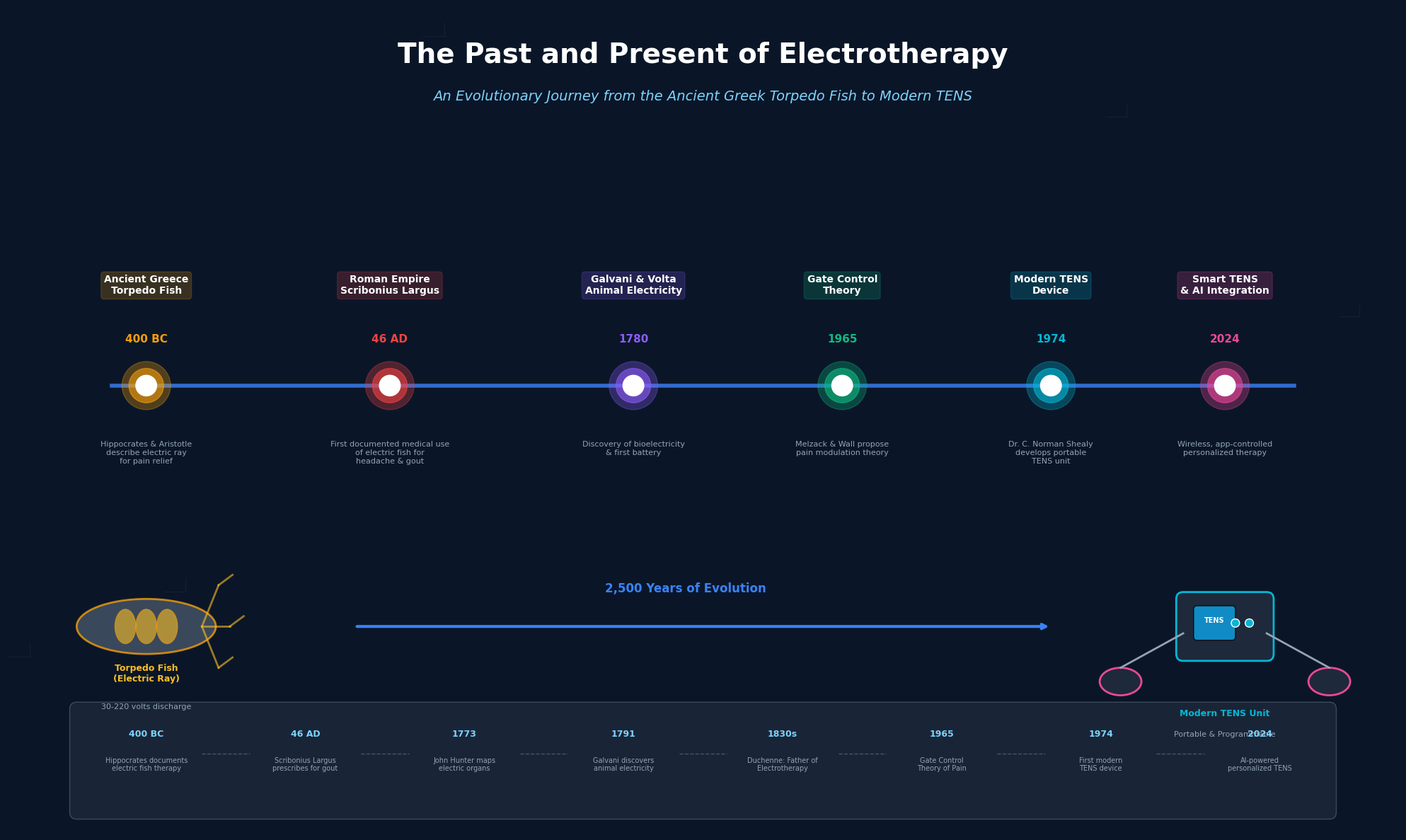
The story begins in the Mediterranean during the first century BCE. Ancient Greek physicians and natural philosophers recorded a peculiar phenomenon: the torpedo fish (electric ray) inhabiting the sea could release a numbing force. Scribonius Largus, a court physician of the Roman Empire, went so far as to recommend in his medical writings that patients suffering from severe headaches or gout should stand barefoot on a damp beach and allow the current discharged by the torpedo fish to pass through their bodies. Although he had no knowledge of what electricity actually was, the sensation of instant numbness and pain relief convinced him that this fish harbored a mysterious healing power. This can arguably be regarded as the earliest clinical record of “electrotherapy” in human history. Primitive as it was, it embodies a simple yet profound truth: electrical signals can interfere with, and even override, the perception of pain.
The Leyden Jar and the Industrial Revolution: The Scientific Germination of Electrotherapy
Moving forward to the mid‑18th century, the invention of the Leyden jar enabled humans, for the first time, to store and discharge artificial electricity at will. During this period in Europe, electrotherapy became a fashionable and somewhat mystical therapeutic practice. Physicians wielded rudimentary electrostatic generators and directed faint electric sparks onto patients’ painful joints or paralyzed limbs. Benjamin Franklin—the scientist who famously flew a kite in a thunderstorm—was himself fascinated by electricity and experimented with using static charges to treat paralysis and neuralgia. Yet, lacking precise understanding of dosage and therapeutic mechanisms, electrotherapy at this stage was largely a groping in the dark, its effects inconsistent and at times tinged with a hint of quackery.
The Scientific Cornerstone of the 20th Century: The Birth of the Gate Control Theory
The transformation of electrotherapy from empiricism to evidence‑based science is owed to a landmark discovery in 1965. Psychologist Ronald Melzack and physiologist Patrick Wall proposed the renowned Gate Control Theory. They were the first to elucidate the physiological mechanism of pain signal transmission at the spinal level: the dorsal horn of the spinal cord contains a regulatory hub that functions like a “gate.” When a large volume of tactile and vibratory signals (transmitted via large‑diameter A‑β fibers) floods in from the skin, this gate partially closes, preventing the finer pain fibers (A‑δ and C fibers) from relaying pain signals to the brain. This theory not only explains why rubbing a bumped area reduces discomfort, but it also provided a robust scientific blueprint for the invention of TENS (Transcutaneous Electrical Nerve Stimulation) devices. TENS works precisely by delivering currents of specific frequencies and intensities to selectively activate those large‑diameter fibers capable of “closing the gate.”
From Hospital to Pocket: The Proliferation of TENS
Building upon the Gate Control Theory, the first portable TENS device appeared in the 1970s. Initially an expensive piece of medical equipment confined to hospital rehabilitation departments and pain clinics, TENS gradually made its way into ordinary households as electronic components became miniaturized and manufacturing costs fell. Today, devices developed by companies like Roovjoy Medical have condensed the once‑bulky apparatus into compact units that can easily slip into a pocket. No longer tethered to wall outlets by cables or requiring constant professional adjustment, patients need only adhere electrode pads to the painful area, press a button, and initiate a “silent revolution” orchestrated by the body’s own natural analgesic system—anytime, anywhere. From the torpedo fish on an ancient Greek shore to precisely modulated bioelectrical signals in the modern era, humanity’s struggle against pain has never ceased, and electrotherapy remains one of the most technologically sophisticated weapons in this enduring battle.
Post time: Apr-30-2026